
FAQ on Seattle Public Schools (SPS) plan to install a synthetic turf field at Wallingford Playfield Park
We want everyone in Wallingford and the schools to be well-informed about this proposed plan before they agree to it. Here are some questions we are often asked.
Update Fri Nov 15:
Seattle Public Schools (SPS) posted that they are now pursuing a half-field plan rather than a full field at Wallingford Park. Once we know more about this plan, we will respond.
Included below are questions we have been asked about our objections to the original plan, first announced by SPS at the Sept 19th meeting. We want people to understand why we objected to that plan.
In our answers, we are firmly committed to accurate, fact-based assessments. We are happy to update this FAQ with new information. If you have new data or information please contact us with citations.
Why do you say LHS also owns the business parking lot that adjoins its large north lot, when other people say it does not?
We are using the King County tax parcel information at kingcounty.gov to make this assessment. The tax parcel says who owns the property. Here is a screenshot and the link so you can verify it yourself. We welcome proof that someone else owns this adjoining lot. Send us email.
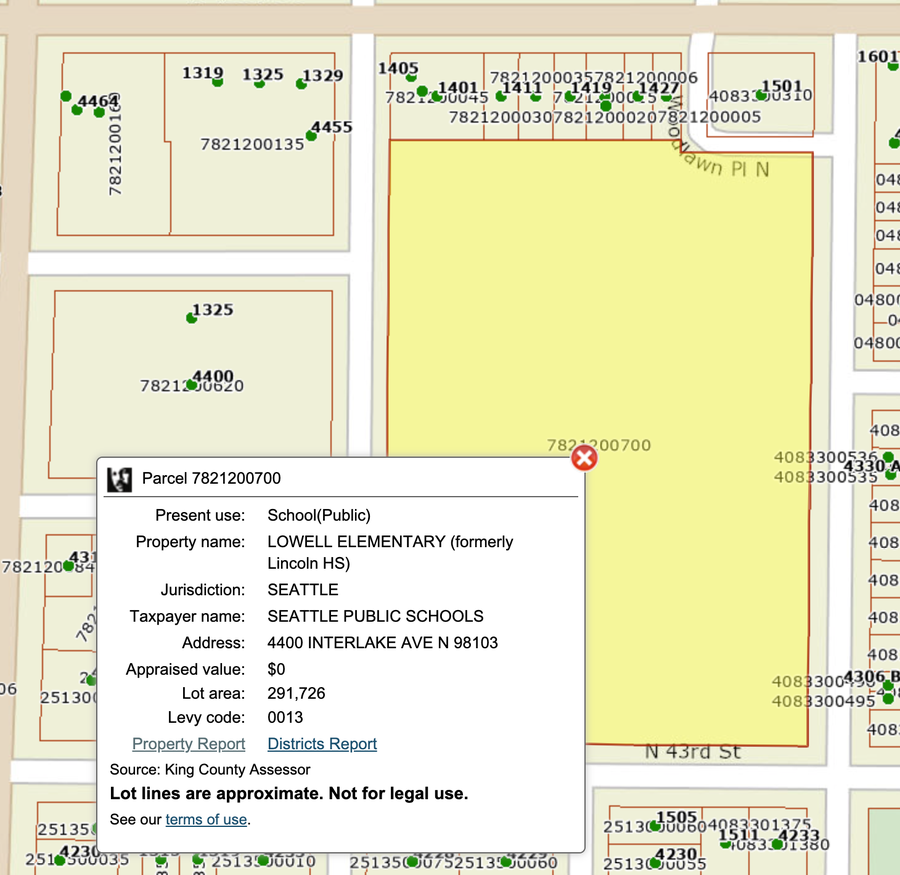
To verify, go to https://gismaps.kingcounty.gov/parcelviewer2/ and enter “4400 Interlake Ave N.”
Why this matters: LHS continues to say that they don’t have the space to build a practice field on site, because they don’t own this particular land. While there may be other issues involved, this data clearly shows that LHS does own this land.
Eighty-five Percent: Where does the 85% of greenspace removed come from?
NOTE: this item responds to the original SPS 9/19 plan. A half-field option would be half the reduction in greenspace.
How we determined this number:
With the help of a professional, we measured the existing natural open greenspace of Wallingford Playfield Park, and then measured the greenspace that would remain after an installation of a synthetic full-sized football field (390 x 190 feet) as the original project proposes.
BEFORE

AFTER

The current greenspace of Wallingford Park includes 75,643 square feet (flat, bright green) plus 13,748 (sloped, dark green), for a total of 89,391, as we show in the Before picture on the left(top).
The proposed synthetic athletic field would reduce open greenspace resulting in: 9,586 (flat) plus 2,736 sf (sloped) of greenspace, for a total of 12,322 square feet, as shown in the After picture on the right(bottom).
The ratio of greenspace, After to Before, is 12,322 / 89,391 which is 13.8%. If the plan for a synthetic turf field were adopted, only 13.8% of prior greenspace would remain.
In other words, 86.2% of the existing natural open greenspace would be removed under this plan.
You say this plan is illegal. How do you reach that conclusion?
NOTE: this item responds to the original SPS 9/19 plan, but it applies to a half-field option as well.
Wallingford Park Alliance retained a lawyer, Richard Aramburu, to explore the legal standing of the school’s proposed plan to change the use of Wallingford Park. Aramburu determined that the proposed plan to install a synthetic athletic field at Wallingford Park, for the purposes described, is illegal.
On November 15 2024, Aramburu sent a 16-page letter detailing the many ways this proposed use is illegal, along with 11 Exhibits to support these assertions, to AP Diaz, Superintendent of Seattle Department of Parks and Recreation. The letter was cc’d to Richard Best, Seattle Public School Director of Capital Planning.
Here is that letter in total, along with the Exhibits.
This legal effort and resulting action were funded by nearly 100 community members via our Go Fund Me page.
Amenities lost: Why do you claim amenities will be lost when SPS says otherwise?
NOTE: this item responds to the original SPS 9/19 full-sized field plan, but some aspects may apply to a half-field option.
SPS writes “the field will be integrated into the existing layout without compromising access to other amenities.”
Here are some of the amenities of Wallingford Playfield Park:
- Playground and its surrounding buffer, including paths
- Wading pool, currently connected to the playground
- Trees, including heritage and exceptional (Tier-1 and Tier-2)
- Wildlife, such as birds, bats, and pollinators
- Walking and jogging path surrounded by grass and trees
- Open grassy areas for picnicking, games, dancing, sitting, and other activities
- Tennis courts
1. SPS has said that the playground will either stay where it is, or will be rebuilt at another location within the park. Given the costs and time needed to move the playground, we expect that SPS would prefer to leave it where it is.
However, if you look at the SPS images provided above, you’ll see that in the first one, the buffer zone of the synthetic turf field overlaps the existing playground. Will the playground shrink? This would be a removal of an amenity.
SPS has said there will be no fence around the field, but no matter where the playground is, it’s hard to see how children and athletes are safe during practice and games on the field without a fence or other barrier.
Furthermore, the park will need to be flattened and graded to accommodate a ten foot rise across the east-west length of the planned synthetic field. The edges of such grading require retaining walls. Those walls will need safety guardrails.
Fence or no fence, there will be a new division between playfield and playground, restricting easy access to either from the other.
It is hard to see how there is room for the existing playground, at its current size, in proximity to the wading pool and the field. If SPS claims otherwise, we would like to see their plans.
2. The wading pool is used as an extension of the playground. Kids play in and around it all year round, as well as on the paths that wind through the trees bordering the wading pool. If the playground is relocated away from the wading pool, the playground and wading pool are separated, changing their fundamental connection and how they are used. This would be a removal of an amenity.
3. A number of exceptional Tier-2 trees will need to be removed in order to accommodate this synthetic field. These mature trees currently provide bird and bat habitat, and mitigate climate change, as well as providing a free play area.
SPS says they will replace any removed trees with saplings. But it’s hard to see how trees that size can be replaced, with less ground available for them to grow. To be healthy and safe a tree needs at least as much ground as its canopy circumference around its center trunk, and that ground cannot be covered with an impermeable surface, such as a synthetic field. This plan doesn’t account for the long-term health of mature trees. This would be a removal of an amenity.
4. Wildlife impact: Until a given sapling reaches maturity – which takes decades – tree canopy, shade, and wildlife habitat have been removed. This negatively impacts the wildlife itself – migrating birds, raptors, owls, and more. This would be a removal of an amenity.
5. The walking and jogging path, while retained in certain sections in the SPS image, directly abuts the field, or is covered by it. Under this plan, this path, now surrounded by trees and grass, becomes surrounded by synthetic turf and its edging. Given the proximity to the field, the path may well end up edged by a safety fence, or retaining wall. This natural path is used daily by many people in our urban village, including walkers, joggers, and wheelchairs. This would be a removal of an amenity.
6. The biggest amenity loss in the SPS proposal is the grassy field. It is currently used for picnics, tai chi, Spikeball, casual sports games, kite-flying, frisbee toss, dance, performances, and so much more. These activities cannot happen on a turf field rented out 90% of the available hours. This would be a removal of an amenity.
7. The tennis courts will remain unchanged.